



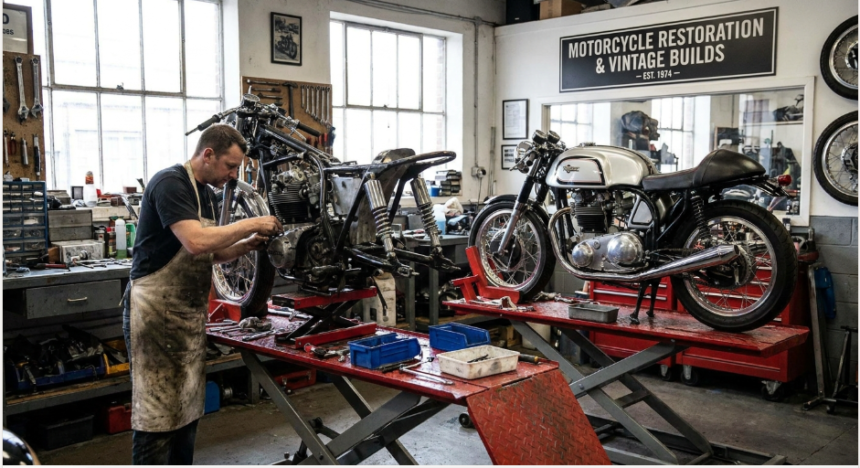
Motorcycle Restoration & Vintage Builds: The world of motorcycle restoration has grown dramatically over the past decade. What was once the quiet obsession of a few dedicated mechanics has become a thriving global community — one filled with builders, collectors, historians, and first-time restorers all united by a shared love of classic machines.
- Why motorcycle restoration is having a moment
- Choosing the right motorcycle for your restoration project
- The motorcycle restoration process: what to expect
- Vintage builds vs. full restoration: knowing the difference
- Tools, budget, and realistic timelines
- The community behind vintage motorcycle restoration
- Frequently asked questions
Whether you are drawn to the raw simplicity of a 1950s British single-cylinder or the muscular elegance of a 1970s Japanese superbike, vintage motorcycle restoration offers a rare combination of mechanical challenge, creative expression, and genuine historical preservation.
But where do you start? And what separates a truly great vintage build from a rushed, poorly executed project that ends up back in the garage gathering dust? This guide walks you through everything you need to know — from finding the right motorcycle to understanding what a full restoration actually involves, and why the vintage build scene continues to captivate so many people around the world.
Why motorcycle restoration is having a moment
It would be easy to assume that interest in old motorcycles is a niche pursuit — the kind of thing that a small group of grey-bearded traditionalists keeps alive in backyard workshops. But the reality is very different. Motorcycle restoration has never been more popular, and the community driving it spans every age group, background, and skill level imaginable.
Part of the appeal is undoubtedly a reaction against the disposable nature of modern consumer culture. In a world where most products are designed to be replaced rather than repaired, restoring a vintage motorcycle feels like an act of genuine rebellion. You are choosing to invest time, skill, and care into something built before planned obsolescence became the norm — and the result is an object that tells a story, carries history, and will likely outlast almost anything manufactured today.
Social media has also played a significant role. Platforms like Instagram and YouTube have given builders a global stage to document their work, and the response has been remarkable. A well-executed vintage build can attract hundreds of thousands of views, inspire other enthusiasts to start their own projects, and even launch careers in custom motorcycle building. The community that has grown around motorcycle restoration is generous, knowledgeable, and genuinely excited about the craft.
Choosing the right motorcycle for your restoration project
The most important decision in any motorcycle restoration project is choosing the right machine to start with. This sounds obvious, but it is surprisingly easy to get wrong — especially if you fall in love with a particular model before properly evaluating its condition and the availability of parts.
For beginners, single-cylinder engines are almost always the best starting point. They are mechanically straightforward, parts are generally easier to source, and the learning curve is far more forgiving than tackling a complex multi-cylinder machine as your first restoration. Classic choices include the BSA Bantam, the Royal Enfield Bullet, and early Honda CB series models from the late 1960s and 1970s — all of which have strong enthusiast communities and solid parts availability.
1950s–60s BSA Gold Star British single-cylinder icon, highly collectible and deeply rewarding to restore
1960s–70s Honda CB series Reliable Japanese engineering with excellent parts availability worldwide
1970s Triumph Bonneville The quintessential British twin — a vintage build favourite for decades
1970s–80s Kawasaki Z series Japanese muscle with iconic styling and a passionate global restoration community
Beyond the model itself, condition matters enormously. A complete motorcycle with a seized engine is usually far more salvageable than an incomplete machine with a running motor — because sourcing missing original parts can be both expensive and frustrating.
Before purchasing any project bike, try to verify that all the major components are present: frame, engine cases, fuel tank, fenders, and wheels. Missing parts can be found, but they will add cost and time to your restoration that should be factored in from the beginning.
The motorcycle restoration process: what to expect
No two restoration projects are exactly alike, but most follow a broadly similar process. Understanding these stages before you begin will save you considerable time, money, and frustration — and will help you make better decisions at every step of the build.
Stage 01-Assessment & strip-down Document everything with photos, then fully disassemble and assess what needs repair, replacement, or sourcing
Stage 02-Frame & metalwork Inspect the frame for cracks, rust, and damage — this is the foundation everything else is built on
Stage 03-Engine rebuild Clean, measure, and rebuild the engine with attention to tolerances, gaskets, bearings, and timing
Stage 04-Electrics & wiring Old wiring looms deteriorate badly — rewiring is often safer and cleaner than repairing the original
Stage 05-Paint & finishing Whether factory-correct or custom, the finish defines the character of the entire vintage build
Stage 06-Assembly & test ride Careful reassembly followed by methodical testing — never skip the final safety checks
Vintage builds vs. full restoration: knowing the difference
One question that comes up regularly in the motorcycle restoration community is the distinction between a full restoration and a vintage build. They are related but not the same thing, and understanding the difference will help you define your own goals before you start turning wrenches.
A full restoration aims to return a motorcycle to its original factory specification as closely as possible — correct paint codes, period-correct components, original decals, and matching numbers where feasible. This approach is favoured by collectors and show bike owners who prioritize historical accuracy and long-term value. A correctly restored original machine will almost always command a higher price among serious collectors than a modified one.
A vintage build, on the other hand, takes a classic motorcycle as a starting point and uses it as a canvas for creative expression. The builder might retain the original engine and frame while updating the suspension, customizing the bodywork, or blending components from different eras to create something entirely new.
Cafe racers, brat-style builds, scramblers, and bobbers all fall under this umbrella — and some of the most stunning motorcycles in the world have come from this style of building.
“The best vintage builds respect the soul of the original machine while giving it a new story to tell — that balance between history and creativity is what makes this craft so endlessly compelling.”
Neither approach is superior to the other. They simply reflect different values and different relationships with the machine. What matters most is that you are clear about your own goals before you invest time and money into a project — because the decisions you make in the early stages will define everything that comes after.
Tools, budget, and realistic timelines
One of the biggest misconceptions about motorcycle restoration is that it requires a professional workshop full of specialist equipment. In reality, most restorations can be completed with a solid set of hand tools, a torque wrench, a multimeter for electrical work, and access to a workshop manual for your specific model. Patience and attention to detail will take you further than expensive equipment ever will.
Budgeting, however, requires honesty. Parts costs for popular vintage models have risen significantly in recent years as demand has outpaced supply, and quality gasket sets, bearings, and chrome components can add up faster than most first-time restorers expect.
A realistic budget for a complete motorcycle restoration on a mid-range classic typically runs anywhere from a few hundred to several thousand dollars depending on the model, condition, and scope of the project.
Pro tip for new restorers
Always buy the best original motorcycle you can afford rather than the cheapest wreck available. A better starting point almost always means a faster, cheaper, and less frustrating restoration — and a far more satisfying result at the end.
The community behind vintage motorcycle restoration
Perhaps the most underrated aspect of the motorcycle restoration world is the community that surrounds it. From dedicated online forums and marque-specific clubs to regional swap meets and international shows like the Handbuilt Motorcycle Show in Austin and Wheels and Waves in Biarritz, the people who build and restore vintage motorcycles are among the most generous and knowledgeable in any enthusiast space.
If you are just starting out, connecting with this community early will save you enormous amounts of time and money. Experienced restorers are often willing to share workshop manuals, advise on parts sourcing, and offer the kind of practical insight that no YouTube video can fully replace.
The motorcycle restoration community genuinely wants to see more people succeed at this craft — and that welcoming spirit is one of the many reasons so many people, once they complete their first vintage build, immediately start looking for their next project.
Frequently asked questions
How long does a full motorcycle restoration take?
A complete motorcycle restoration typically takes anywhere from six months to two or more years depending on the model, condition, parts availability, and how many hours per week you can dedicate to the project. Patience is not optional — it is a core part of the process.
What is the best classic motorcycle to restore for a beginner?
For beginners, single-cylinder bikes with strong parts availability are ideal — Honda CB100s, CB200s, and Royal Enfield Bullets are all excellent starting points that won’t overwhelm you mechanically while still delivering a hugely rewarding result.
Is motorcycle restoration expensive?
Costs vary widely depending on the model and scope of work, but a realistic budget for a complete restoration on a popular vintage motorcycle typically ranges from $1,000 to $5,000 or more once parts, paint, and consumables are factored in.
What is the difference between a restoration and a custom vintage build?
A restoration aims to return a motorcycle to its original factory condition, while a vintage build uses a classic motorcycle as a creative foundation — modifying, blending, and reimagining components to create a unique, personalized machine.
Where can I find parts for vintage motorcycle restoration?
Parts can be sourced through marque-specific clubs, specialist dealers, online marketplaces like eBay and Craigslist, swap meets, and dedicated vintage motorcycle shows — and connecting with an owner’s club for your specific model is often the single fastest route to rare or hard-to-find components.